India, Denmark, and the Quiet End of K-Beauty's Monopoly
South Korea built the beauty innovation playbook. Nextatlas data shows the fastest growth signal has moved to India, Denmark, France, and Brazil, and the brands paying attention are already there. See what's driving Skin Barrier and Biomimetic Beauty trends.
For years, "fastest growing beauty market" was shorthand for one country. South Korea built the innovation infrastructure the rest of the world borrowed from: the ten-step routines, the ingredient science, the export machine that turned skincare into a global obsession.
That engine still runs but the consumer signal driving beauty forward has moved to a wider map, and the two forces reshaping it, Skin Barrier and Biomimetic Beauty, are pulling growth toward very different geographies.
Skin Barrier: The Mature Signal With the Highest-Ever Trajectory
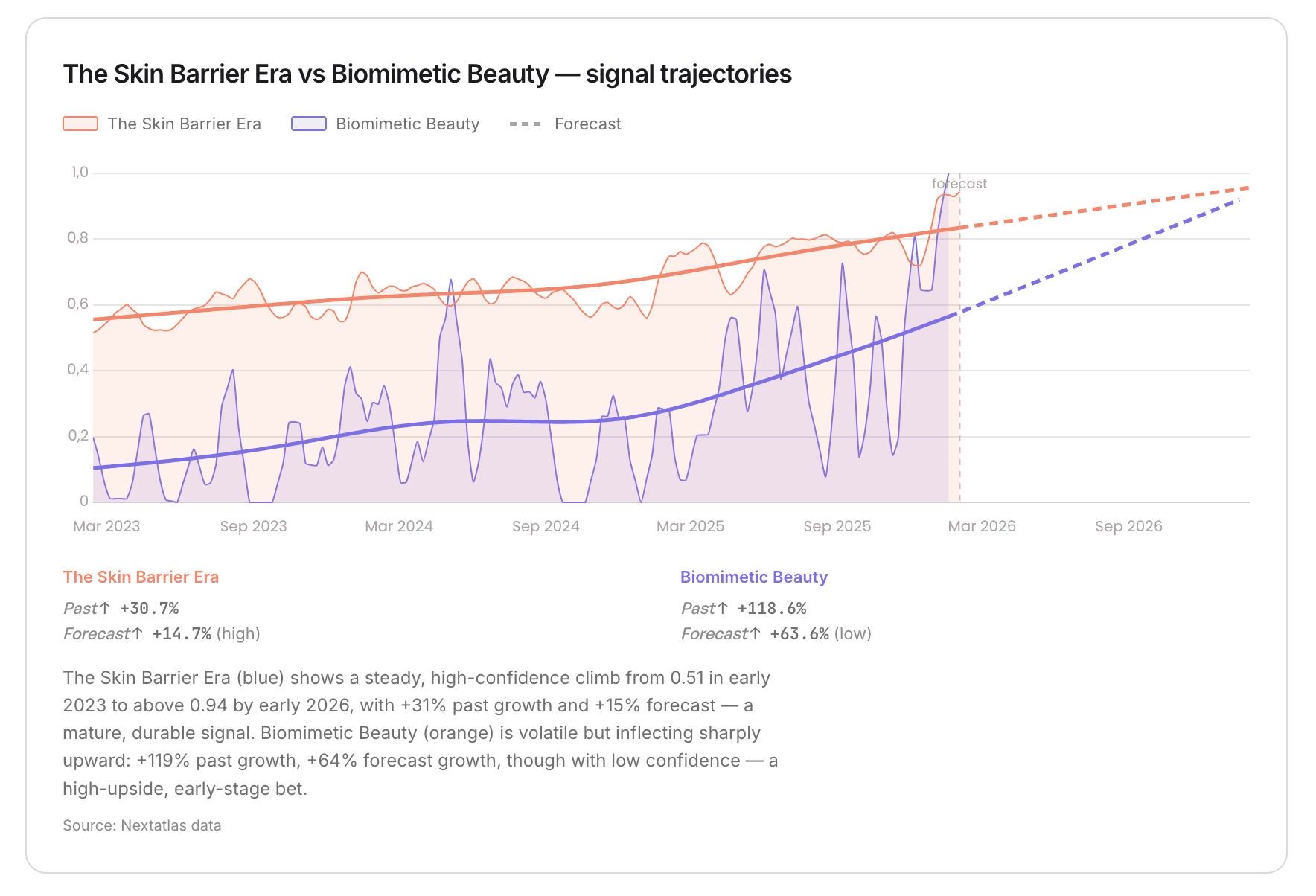
Skin Barrier has been compounding for three years, and Nextatlas data shows it climbing from 0.51 in early 2023 to above 0.94 today, with 31% past growth and a high-confidence +15% forecast. This is a signal that has already earned shelf space and keeps expanding.
The geography behind it upends the K-beauty assumption entirely. India ranks first by a significant margin, with Denmark and Japan competing for second. South Korea sits tenth, present but no longer the driving force.
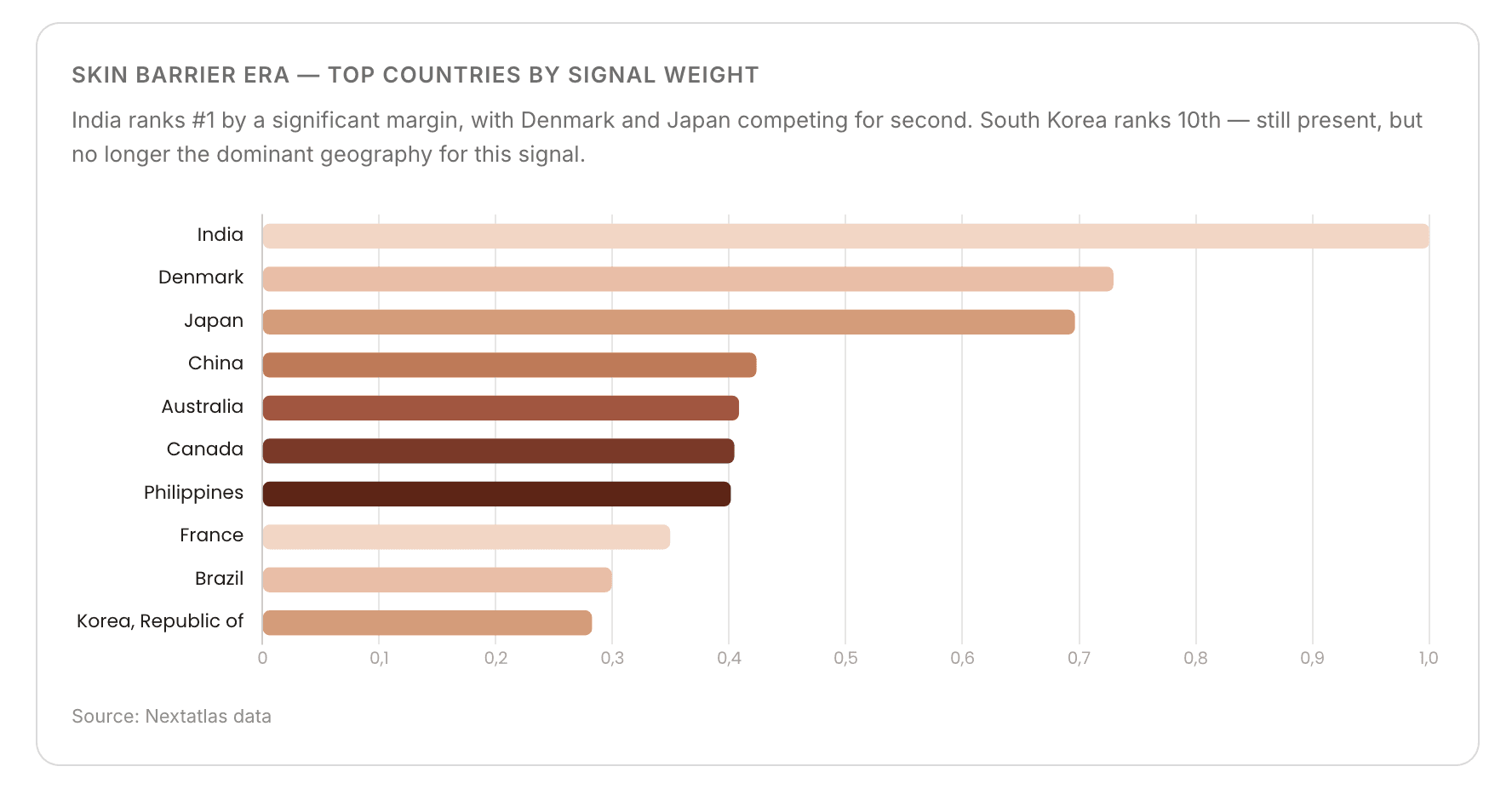
India's rise tracks a structural shift: an expanding middle class entering science-backed skincare at scale, pushed by climate-driven skin stress (pollution, humidity) that makes barrier-repair messaging immediately relevant. Denmark's presence signals Nordic minimalism converging on the same formulation philosophy from the opposite direction: restraint and clinical proof rather than climate urgency.
The audience behind Skin Barrier is Gen Z and Millennials, majority female. 56% of the content lives on Instagram, but the education itself happens elsewhere: 77% of Skin Barrier Repair content specifically runs on TikTok, in short-form, tutorial-led, peer-to-peer formats.
The Market is Moving
Dr. Jart+ relaunched its Ceramidin line in March 2026 with a moisturizing cream carrying double the ceramide concentration alongside panthenol, doubling down on barrier repair as the brand's core promise rather than a seasonal add-on.
Medicube, the K-beauty brand known for its pink collagen barrier line, entered the Indian market in 2026 through Tira, going directly after the exact demographic the signal identifies: Gen Z and Millennial women encountering science-backed skincare at scale for the first time.

Credits: Indian Retailer
Together these two moves capture the split running through the data. One is a legacy K-beauty innovator deepening its barrier claim at home. The other is that same K-beauty machine following the signal to where the growth actually is.
Biomimetic Beauty: The Volatile, High-Upside Bet
Where Skin Barrier is mature and confident, Biomimetic Beauty is the opposite kind of opportunity: +119% past growth, but with low forecast confidence around a still-strong +64%. The signal is real, and the white space is still wide open.
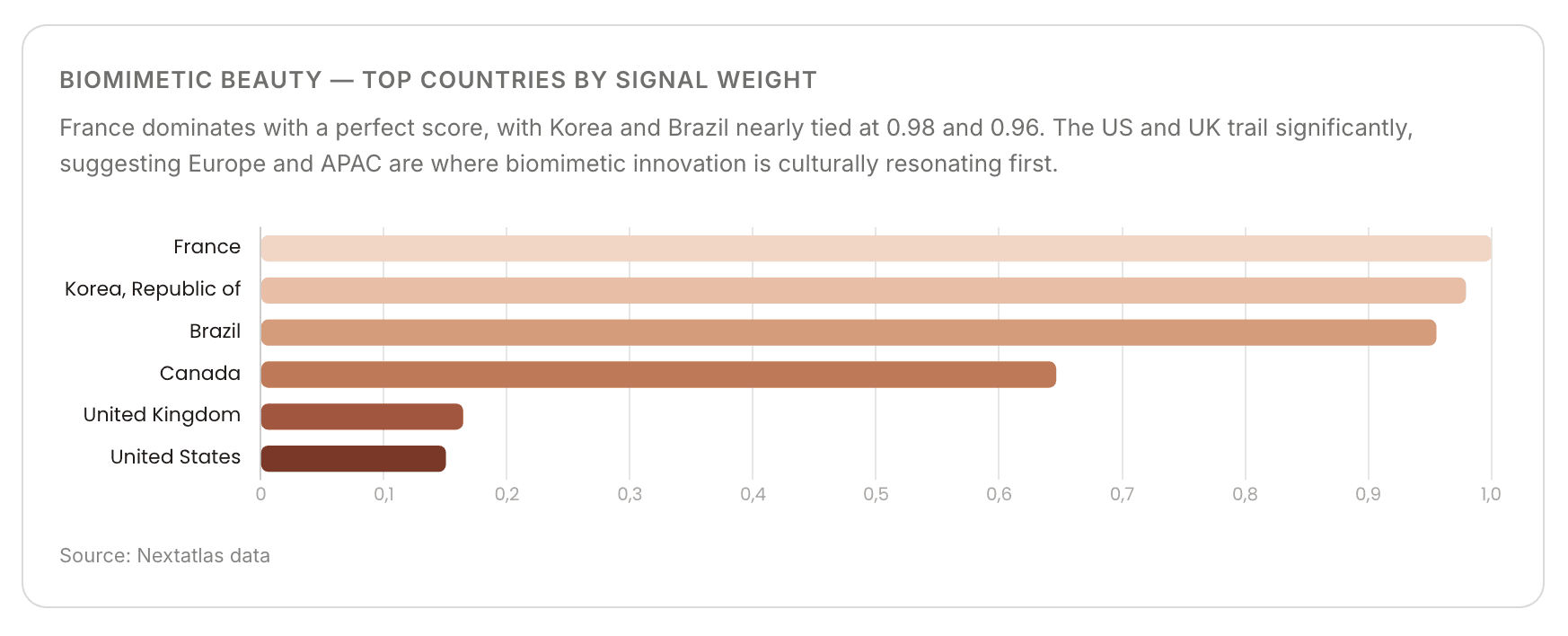
Geographically this is a different cluster entirely. France leads with a perfect signal-weight score, followed closely by Korea and Brazil, while the US and UK trail well behind. Europe and APAC are where biomimetic ideas are resonating culturally first.
The audience shifts too, skewing Millennial rather than Gen Z. This is a trend the beauty industry's own insiders are tracking before it reaches mainstream consumer language.
The Market is Moving
France's dominance in this signal is already showing up in launch calendars.
LipoTrue unveiled two biomimetic actives at in-cosmetics Global in Paris in April 2026: Waspilk, a peptide modeled on spider lifeline silk built to reinforce dermal structure, and CO///A3, a collagen III fragment grown through vertical farming rather than extracted from animal or synthetic sources. Both actives were positioned as biology-first, lab-to-market ingredients rather than conventional synthetics.
Mimétique, a French dermocosmetics brand launched by chemist Fabienne Sebaoun with AgroParisTech, built its entire range around a five-ingredient complex the brand calls Skin Mimetic Restore, using actives already naturally present in skin to strengthen its structure. The line carries over 25% active concentration across every product, a clinical-grade positioning aimed squarely at the Creative Director and insider audience the signal identifies.
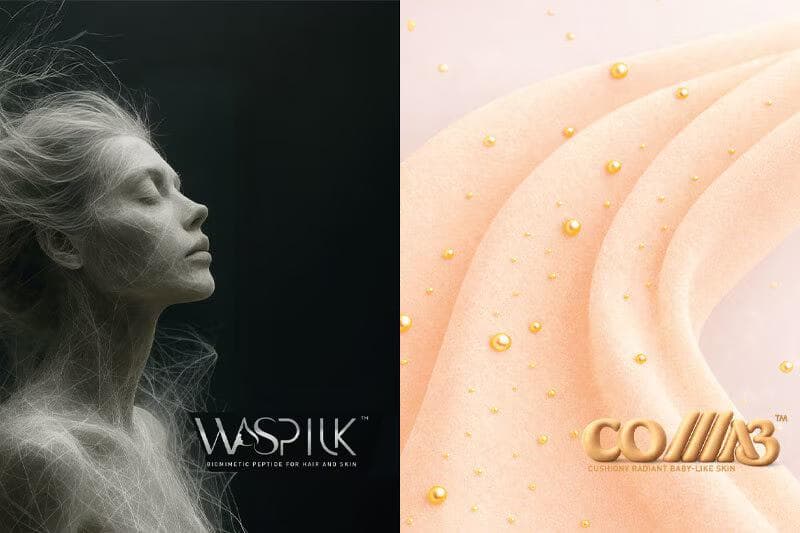
Credit: LipoTrue
Two Markets, One Philosophy
Two markets that look unrelated on the surface, India and Denmark, are actually converging on the same formulation philosophy from opposite directions: one driven by climate urgency, the other by Nordic restraint. Brands that can hold both narratives under a single positioning, resilience and clinical proof, have a genuine multi-market opening rather than a single-country play.
The Strategic Read
The barriers worth planning around: extreme regulatory fragmentation across India, Korea, Japan, and Australia; price accessibility challenges for premium bioactive SKUs in India and Southeast Asia; and the high distribution cost of entering K-beauty and J-beauty markets that already have entrenched local incumbents.
South Korea remains an innovation powerhouse. It's simply no longer where the fastest consumer-signal velocity lives. The next wave of beauty growth is being written in India, Denmark, France, and Brazil, and the brands that notice first will be the ones setting the terms of the conversation rather than following it.
Trend lines, data, and information described in this article emerge from the ongoing analysis performed by Nextatlas on its global observation pool made of innovators, early adopters, and industry insiders. Discover Nextatlas Methodology →