Human Density: Artificial Is Not the Opposite of Human
Artificial is not the opposite of human. A different metric for anything we make, and a different way to read what AI is. Adapted from Luca Morena's talk at Supernova Agencies 2026.
There is a kind of clip that circulates under the caption "I love when humans human." People crowding a square, talking on a terrace, lying on the grass. The caption assumes there is an activity called humaning: something we do and other things do not.
Most of the conversation about AI rests on that assumption. Debates about real creativity, authentic intelligence and soulless machines all presuppose a clean line between what we make and what we are. This piece examines it.
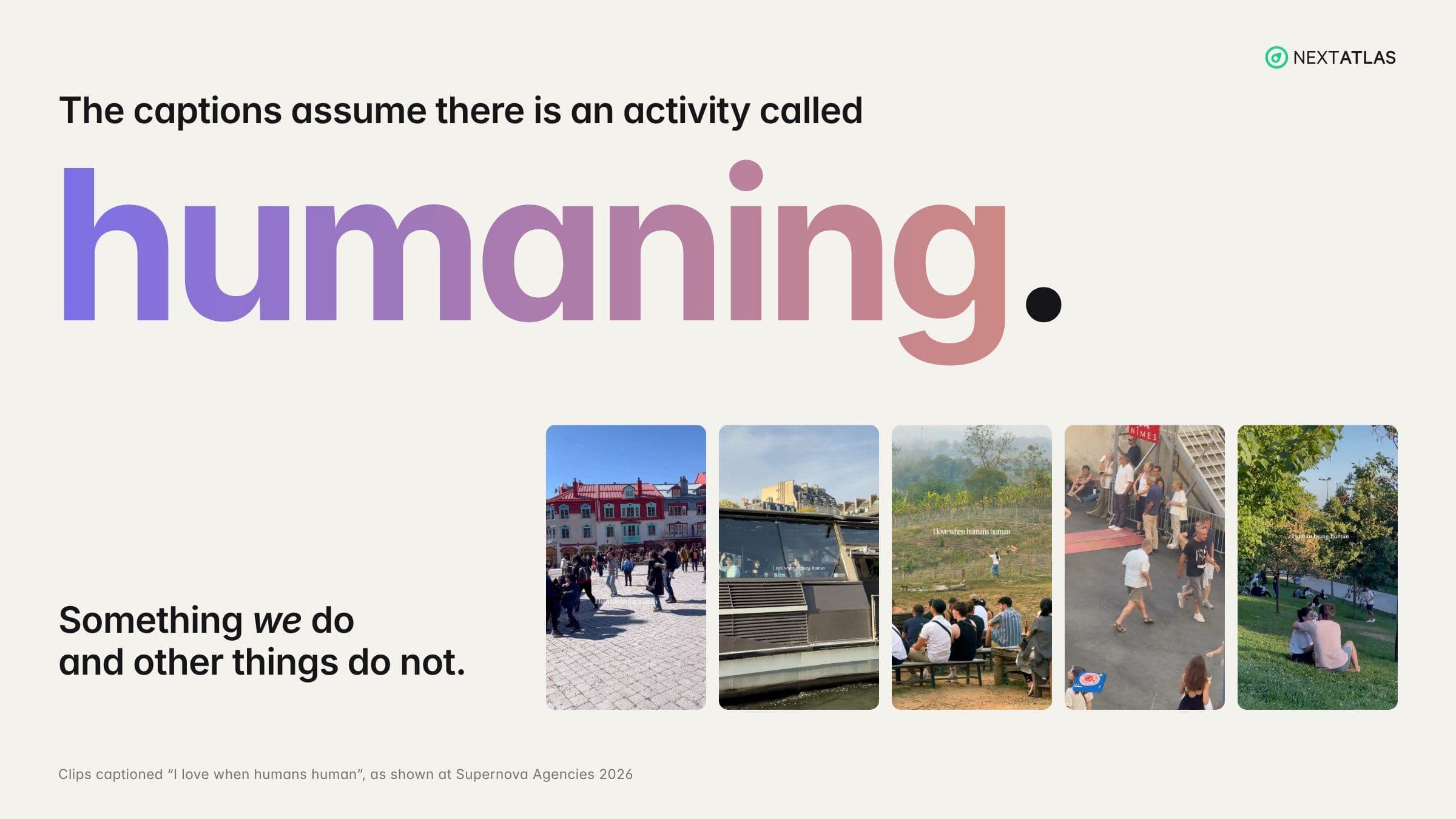
Something we do and other things do not.
The line keeps moving
Nextatlas tracks the conversations of more than 300,000 early adopters. Over the past two years, talk about what is "uniquely human" grew 60% in this community, and has held that level since March. It does not travel alone. Discernment rose 58%. Meaningful, 49%. Judgment, 44%. Good taste, 22%. Human review, human expertise, genuine human connection, real humans: all climbing.
If a single property separated us from machines, the conversation would narrow towards it. It keeps widening. The search for a dividing line shows how fragile the opposition always was.
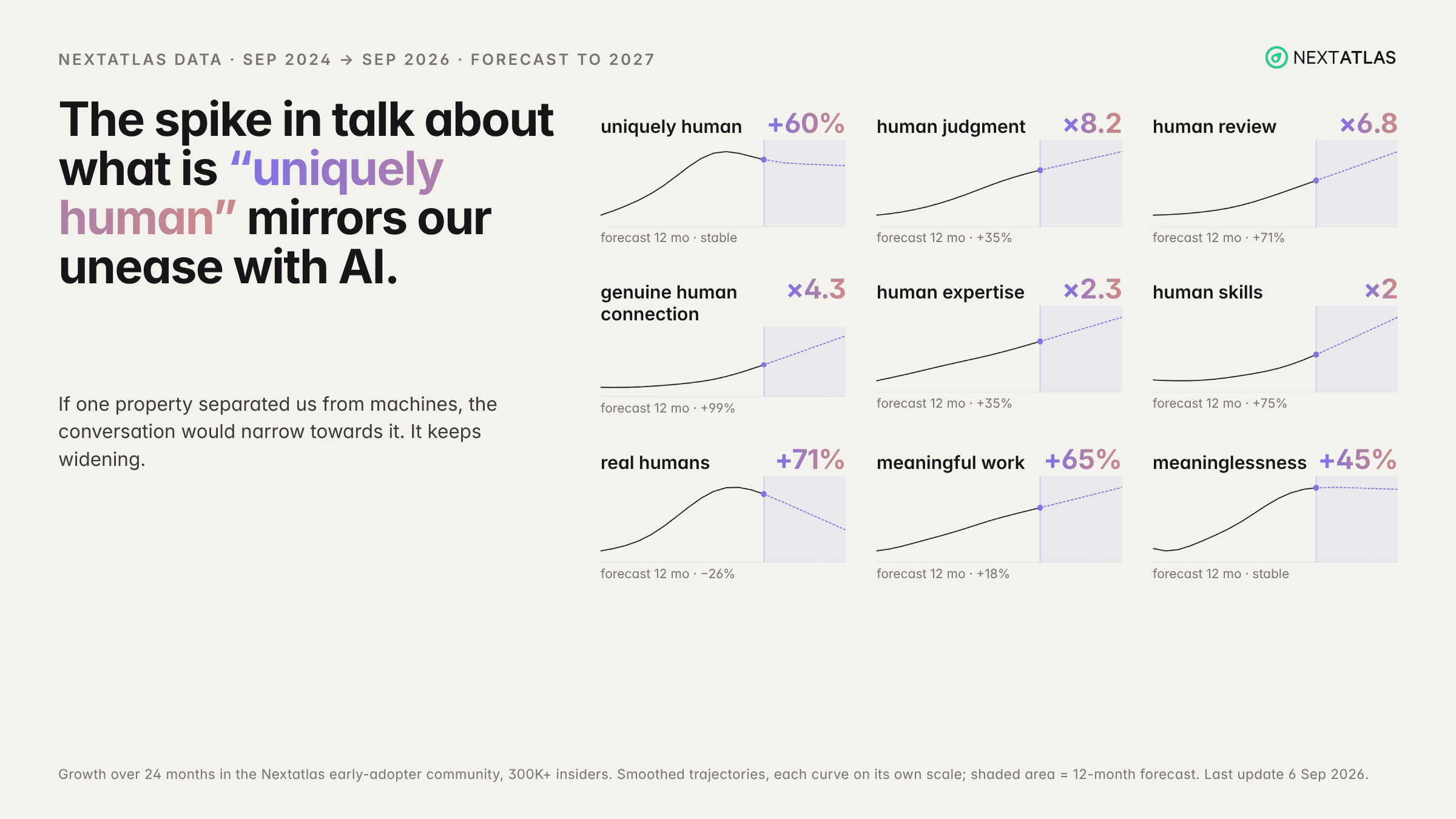
Nextatlas data: growth over 24 months in the early-adopter community, with 12-month forecasts. Last update 6 September 2026.
Which one is more human?
Put the Manhattan skyline at dusk next to Jezero crater on Mars. Which is more human?
Obviously the skyline. It bears the fingerprints of our species, saturated with our desires, contradictions and histories. Nobody hesitates. So we already sense that humanness comes in amounts. We lack a word for it.
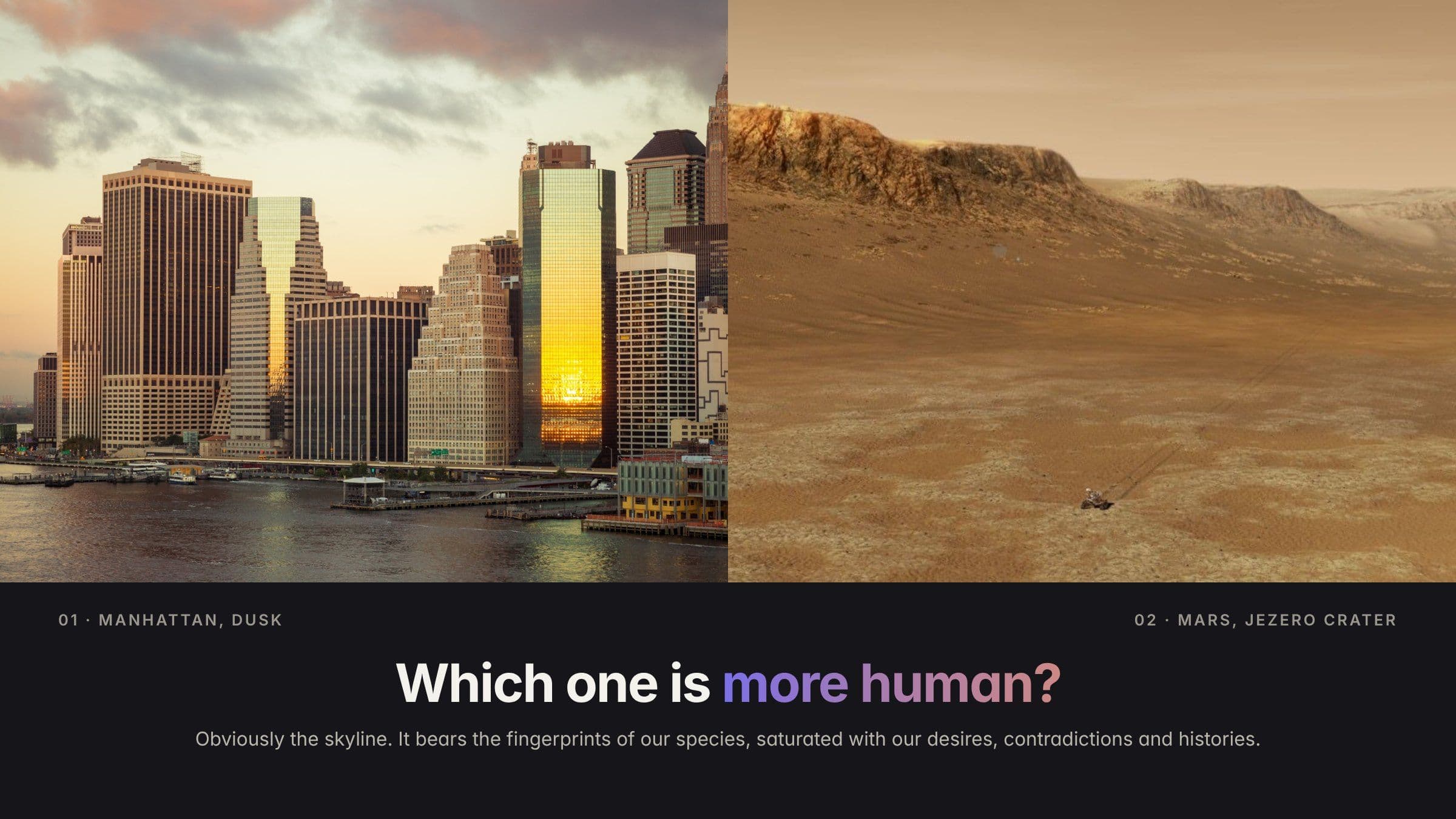
Manhattan at dusk. Jezero crater, Mars.
A definition
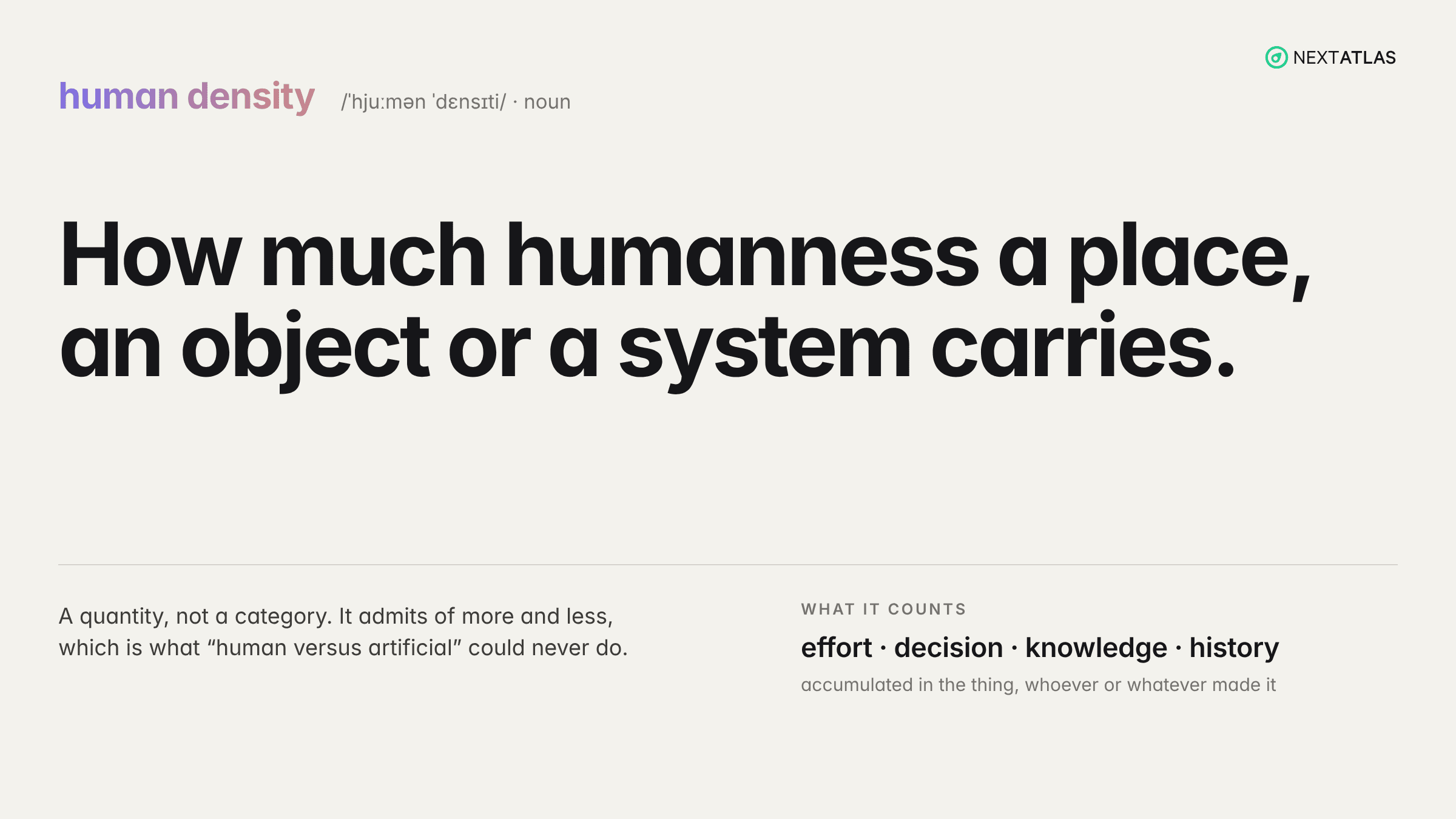
Human density /ˈhjuːmən ˈdɛnsɪti/ · noun. How much humanness a place, an object or a system carries.
It is a quantity. It admits of more and less, which is what "human versus artificial" could never do. What counts is effort, decision, knowledge and history, accumulated in the thing, whoever or whatever made it.
In Bordighera, on the Ligurian coast, a former church now houses a bookshop. Faith, memory, knowledge, commerce, stacked into a single space. Density accumulates.
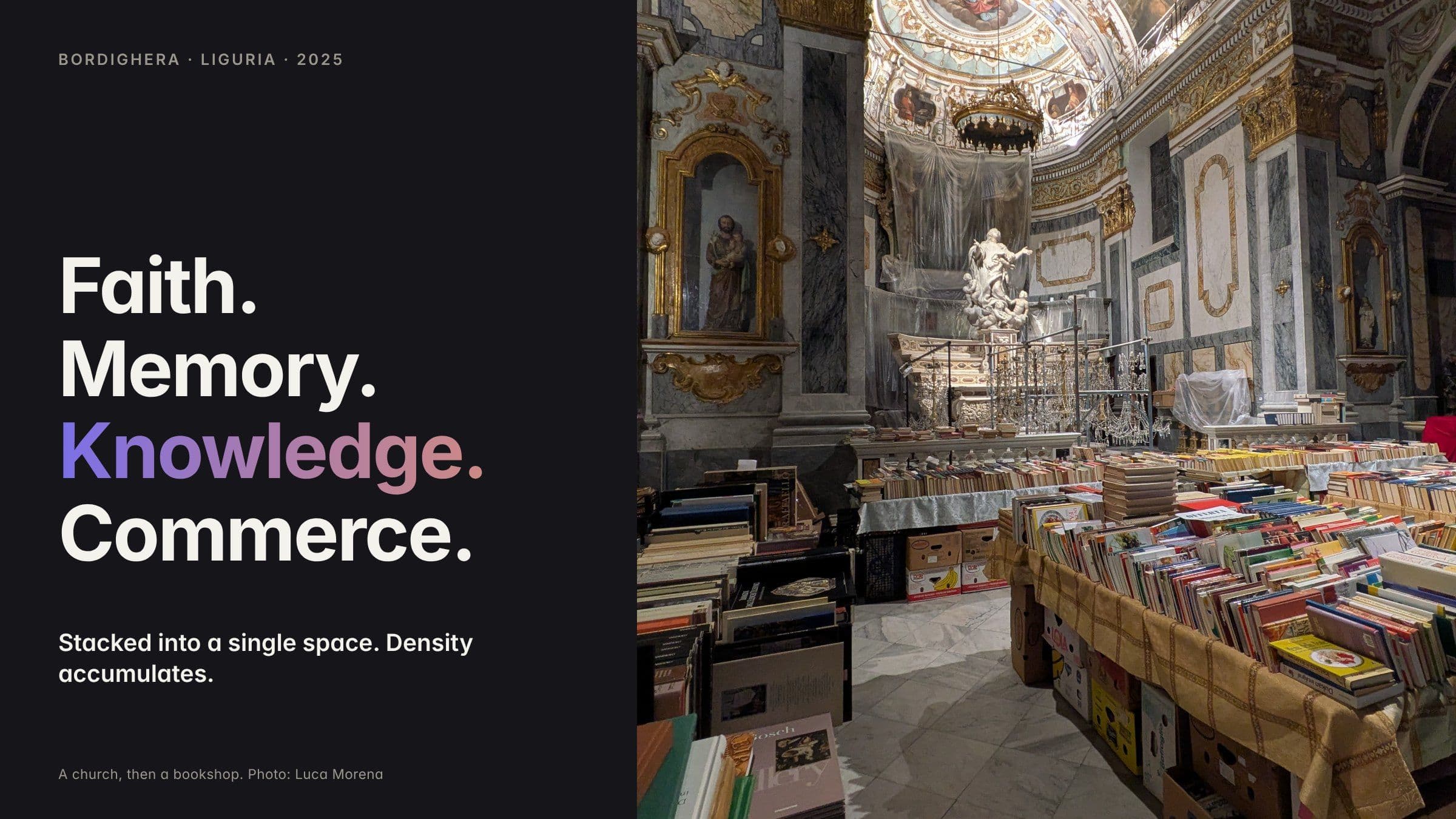
Bordighera, Liguria. A church, then a bookshop. Photo: Luca Morena.
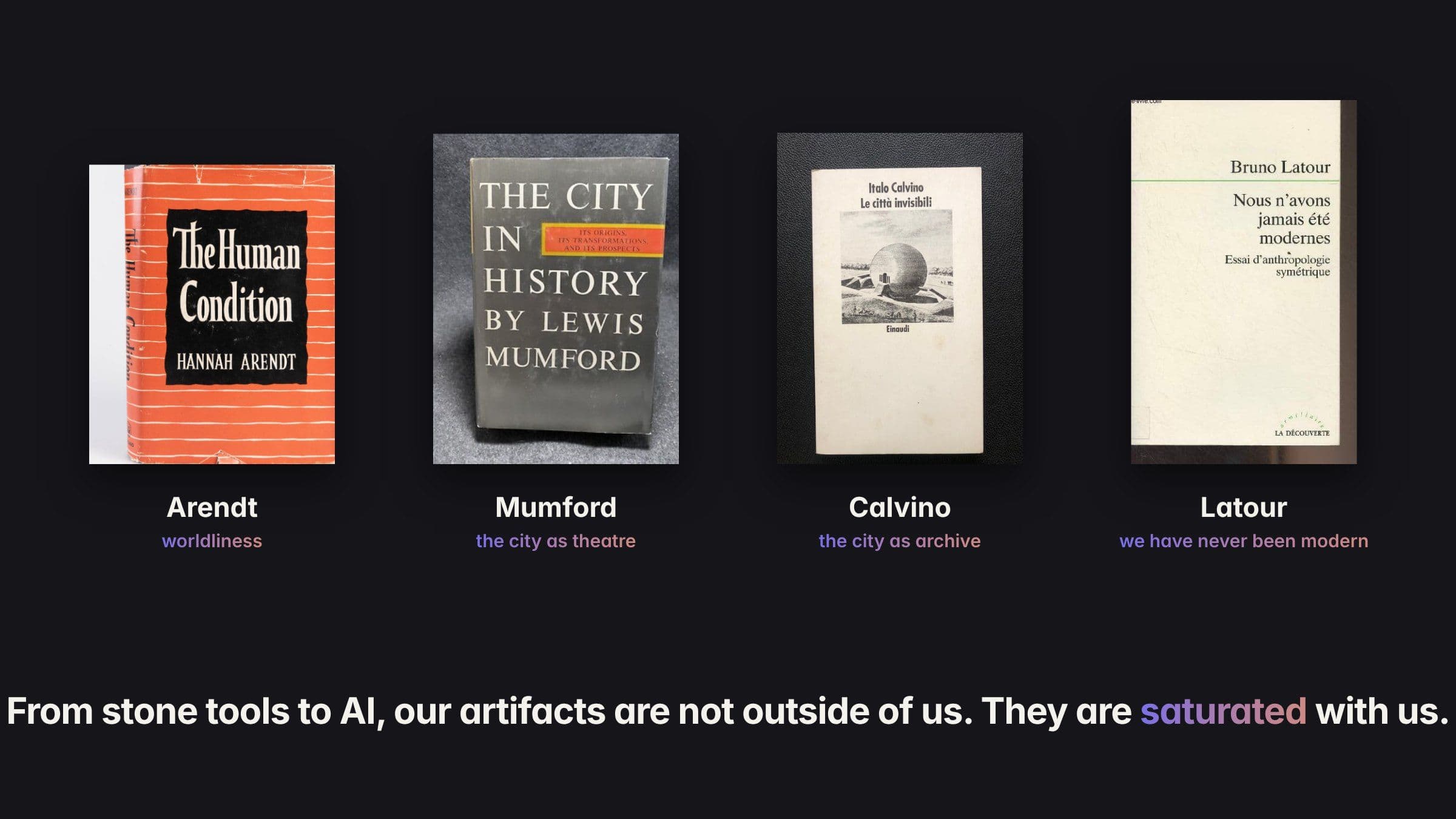
The idea has a long lineage. Hannah Arendt saw the fabricated world of durable objects as what gives us a shared home that outlasts any single life. Lewis Mumford read the city as a theatre of social action. Italo Calvino's Zaira keeps its past inscribed in the angles of its streets. Bruno Latour argued that the split between nature and culture, human and nonhuman, was always a fiction: we have never been modern.
From stone tools to AI, our artifacts are not outside of us. They are saturated with us.
The densest thing we have made
Seen this way, AI is the most human-dense thing we have ever made. Every model is built from what people have written, drawn, argued and corrected.
Human-dense does not need to be human-like. Whether a model talks like a person is a design choice. The pauses, the "hmm", the friendly tone are added on purpose. They add nothing to its density.
Two ways to get the human wrong
If there is no real line, "human" cannot be used to tell things apart. Yet the word is used that way more and more, in two opposite practices.
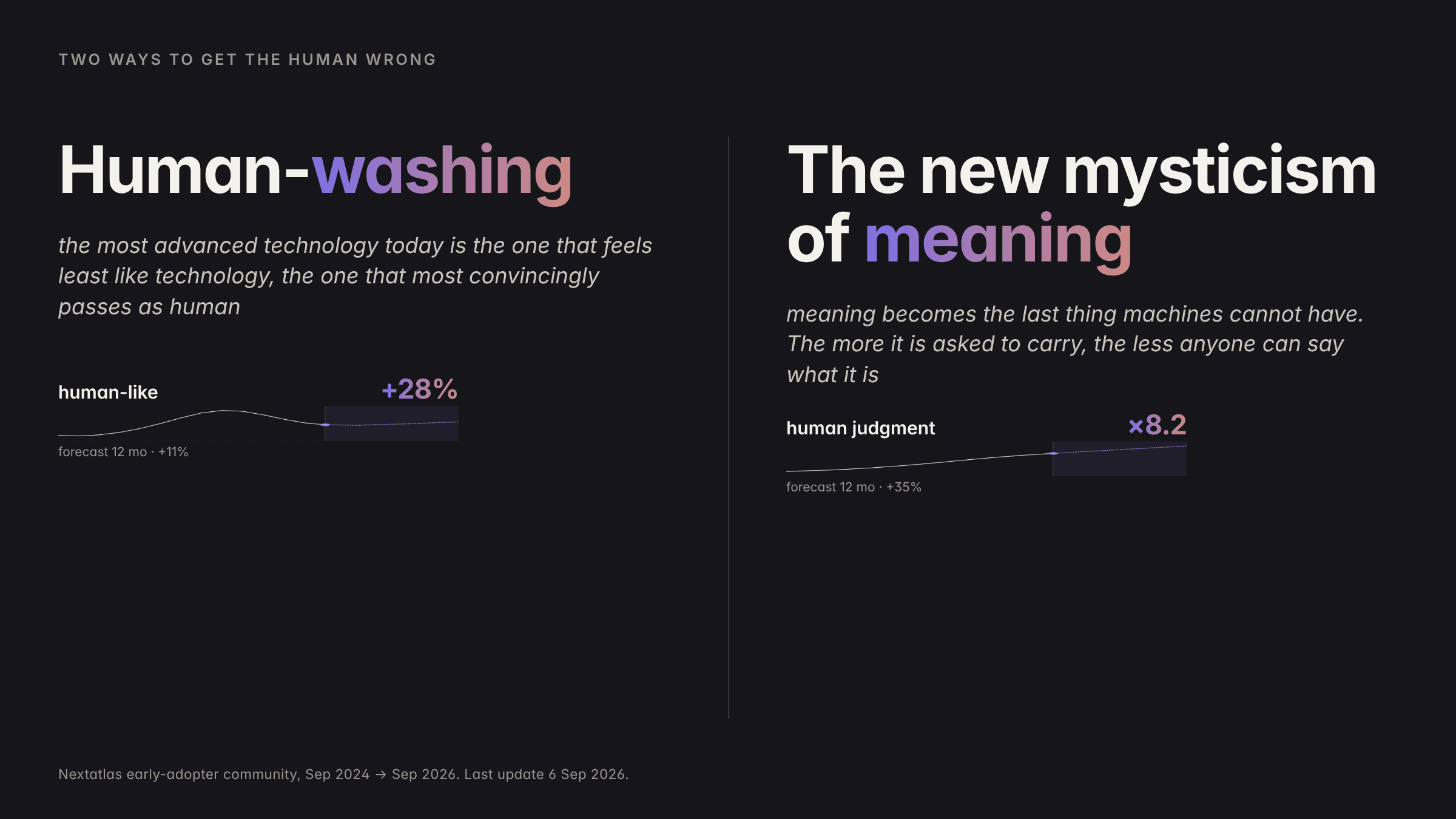
Human-washing
For most of the modern era, technology impressed us by being unlike us. That has reversed. The most advanced technology today is the one that feels least like technology, the one that most convincingly passes as human. Assistants hesitate, chatbots copy our tone, humanoid robots are judged on faces and gait.
It follows the pattern of every washing. A value becomes mandatory, its substance is hard to check, its surface is easy to produce. And it teaches us to measure humanness by behaviour. A chatbot that says "hmm" seems more human than the same model returning a table, though both contain as much of us.
There is a counter-current. MicroDuck, a small open-source robot from the LeRobot community, is a duck head on two legs. No face to trust. People love it anyway. In Nextatlas data, conversation about humanoid robots spiked and is forecast to fall by two thirds. MicroDuck barely existed a year ago and is forecast to grow more than sixfold.
The dignity of the machine is being its own kind of thing. Ours is being met by something that does not need to pretend to be us. The systems being built now will attend, reason and fail in ways that do not map onto ours. Dressing them as people hides exactly what we need to see.
The honest machine is still full of us: every joint, every tolerance, every decision about what it should do. Otherness leaves density intact. Passing is what erodes it.
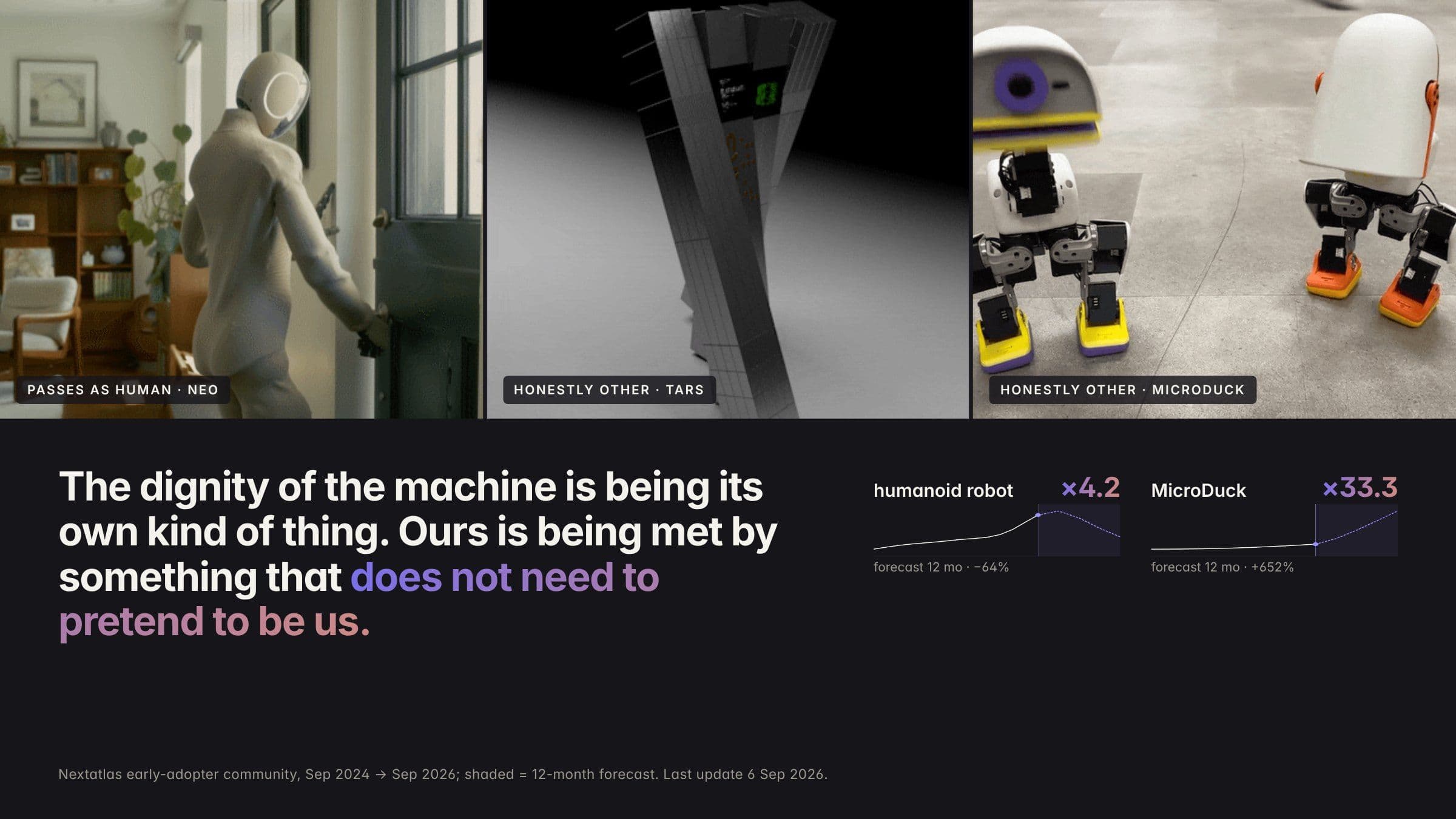
Passes as human, honestly other. Nextatlas data, September 2024 to September 2026, with 12-month forecasts.
The new mysticism of meaning
The second practice guards the line instead of crossing it. Meaning becomes the last thing machines cannot have.
The usual story says our age destroyed meaning and we now reach for it in its absence. That story needs a golden age that never existed. Philosophers never agreed on what meaning is. What has gone is the social agreement that let us act as if we did.
So meaning has become the new authenticity. Nobody says what it is. Everyone spends it. In Nextatlas data the word attaches to experiences, work, contribution, dialogue: six uses, all rising over two years, none defined. That is inflation. The more it is spent, the less it buys. Like religious language, it keeps its authority only while no one asks what it refers to.
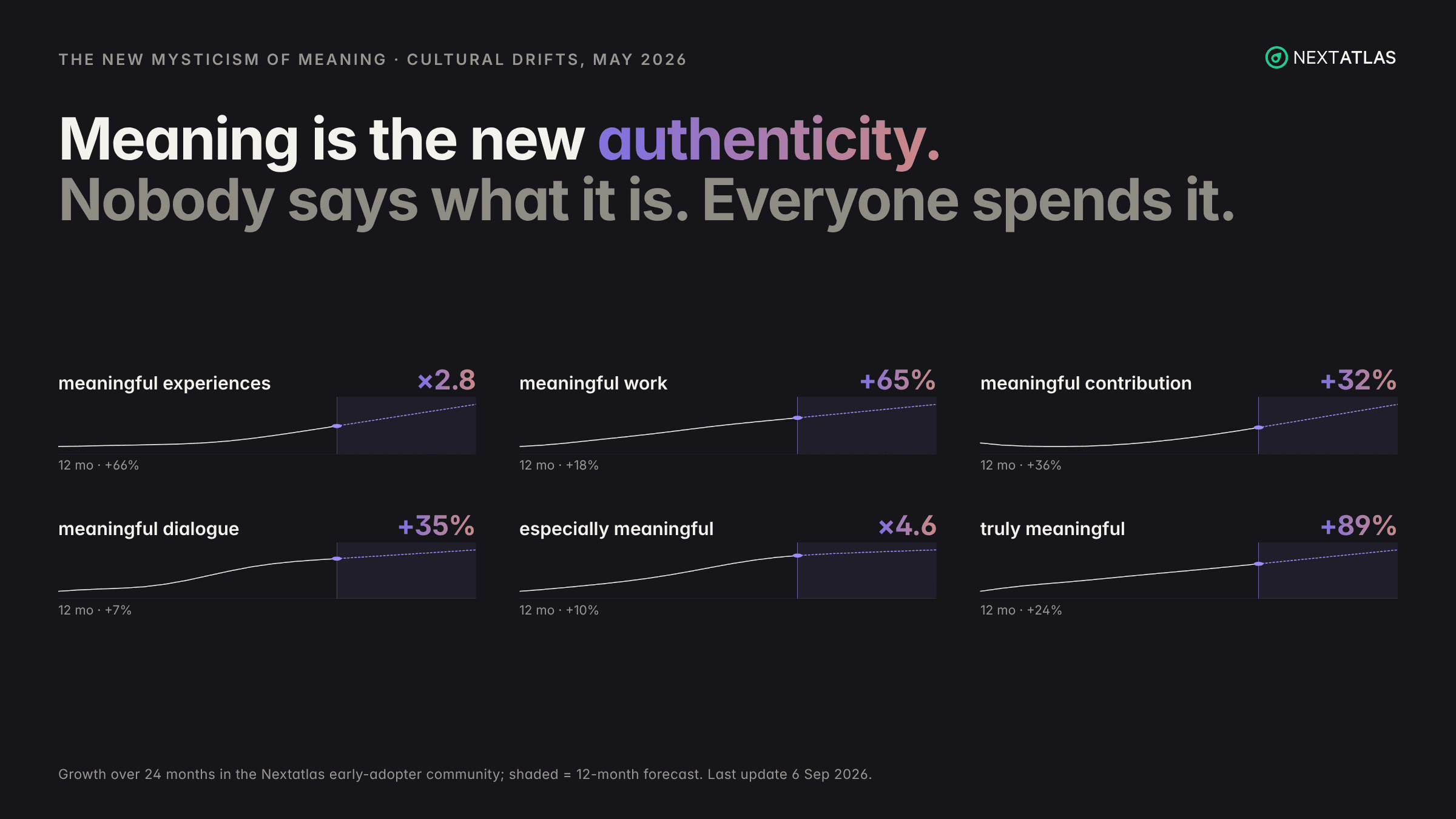
Nextatlas data: six uses of "meaningful", growth over 24 months with 12-month forecasts.
Density is not meaning
If human density were another word for meaning, this argument would commit the fault it criticises.
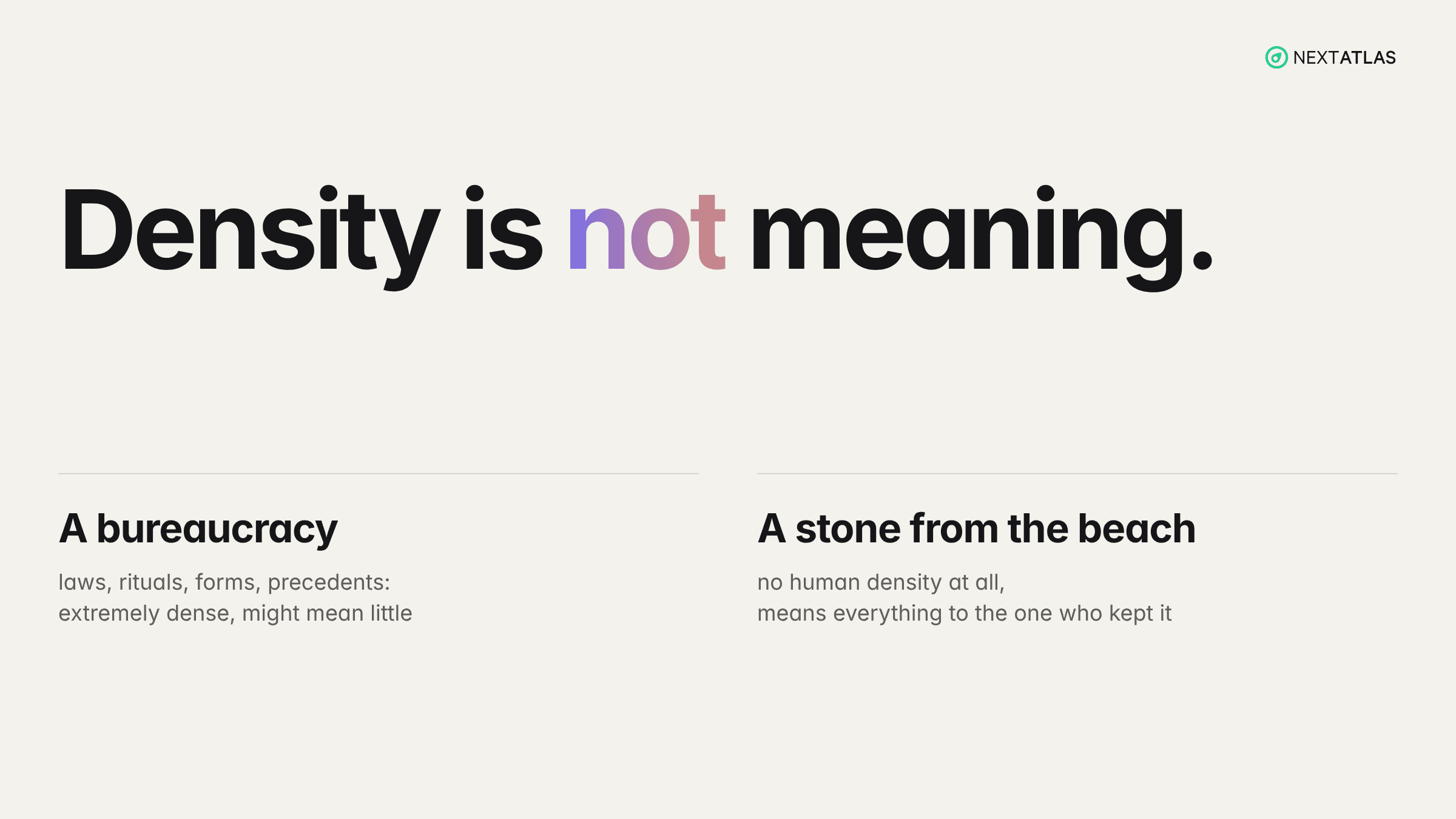
A bureaucracy is as dense as anything humans have made: laws, rituals, forms, precedents, centuries of practice. Nobody calls it meaningful. A stone picked up on a beach has no human density at all. Nothing was made, nothing was decided. It can mean everything to the person who kept it.
Meaning, in its current use, is defined by exclusion: whatever AI cannot have. It is projected onto a thing. Density is defined by content. It sits in the thing, can be traced, and excludes nothing in advance.
For the people who make things
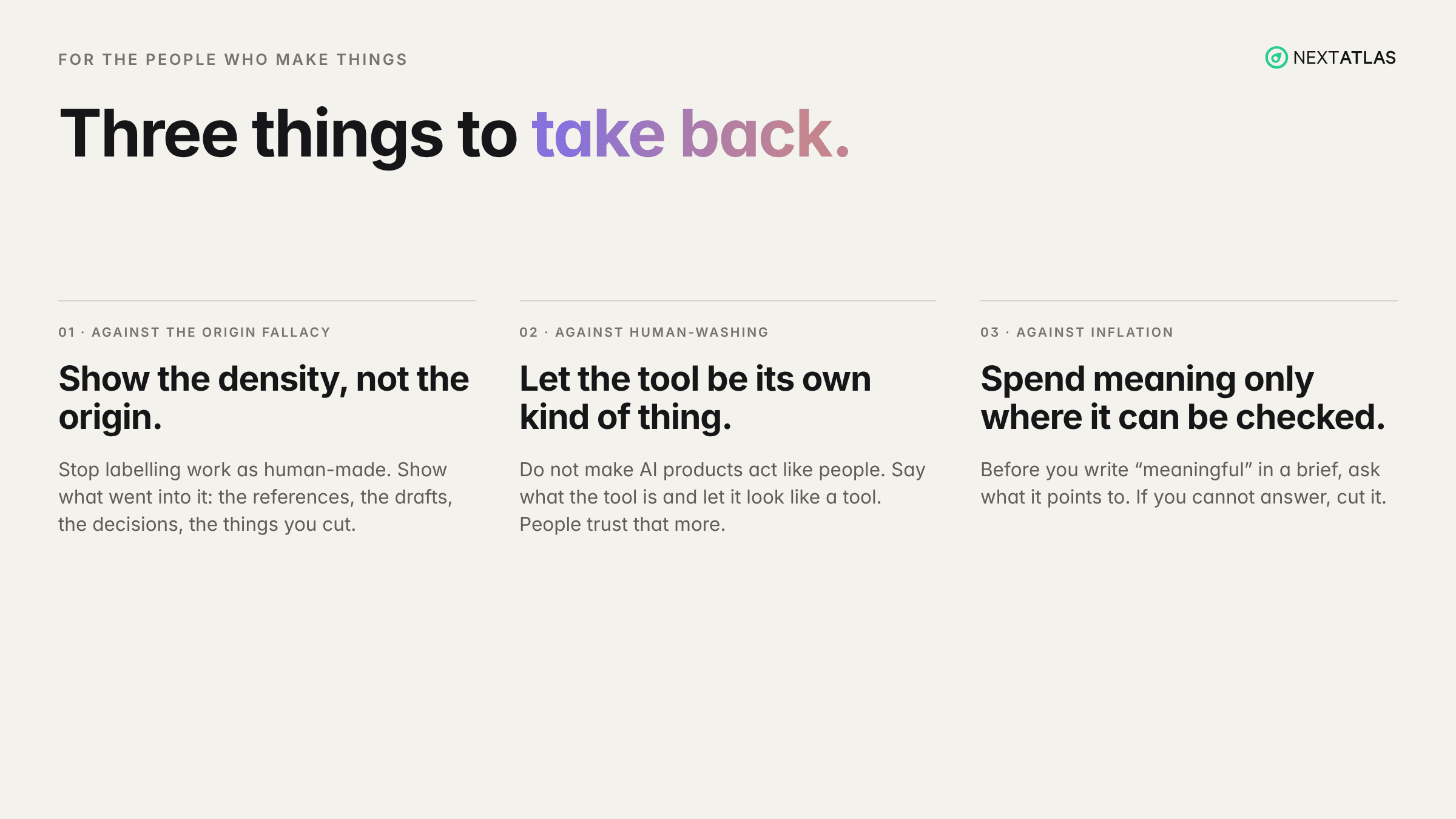
Three things to take back to the studio.
- Show the density, not the origin. "Human-made" is a claim about who. Density is a claim about what, and it can be shown: the references, the drafts, the decisions, the things you cut. That is what people can see and trust.
- Let the tool be its own kind of thing. Do not make AI products act like people. Say what the tool is and let it look like a tool. Honesty about what it is reads as trust.
- Spend meaning only where it can be checked. Before writing "meaningful" in a brief or a campaign, ask what it points to. If you cannot answer, cut it. Every unchecked use devalues the ones that can be checked.
Full of us
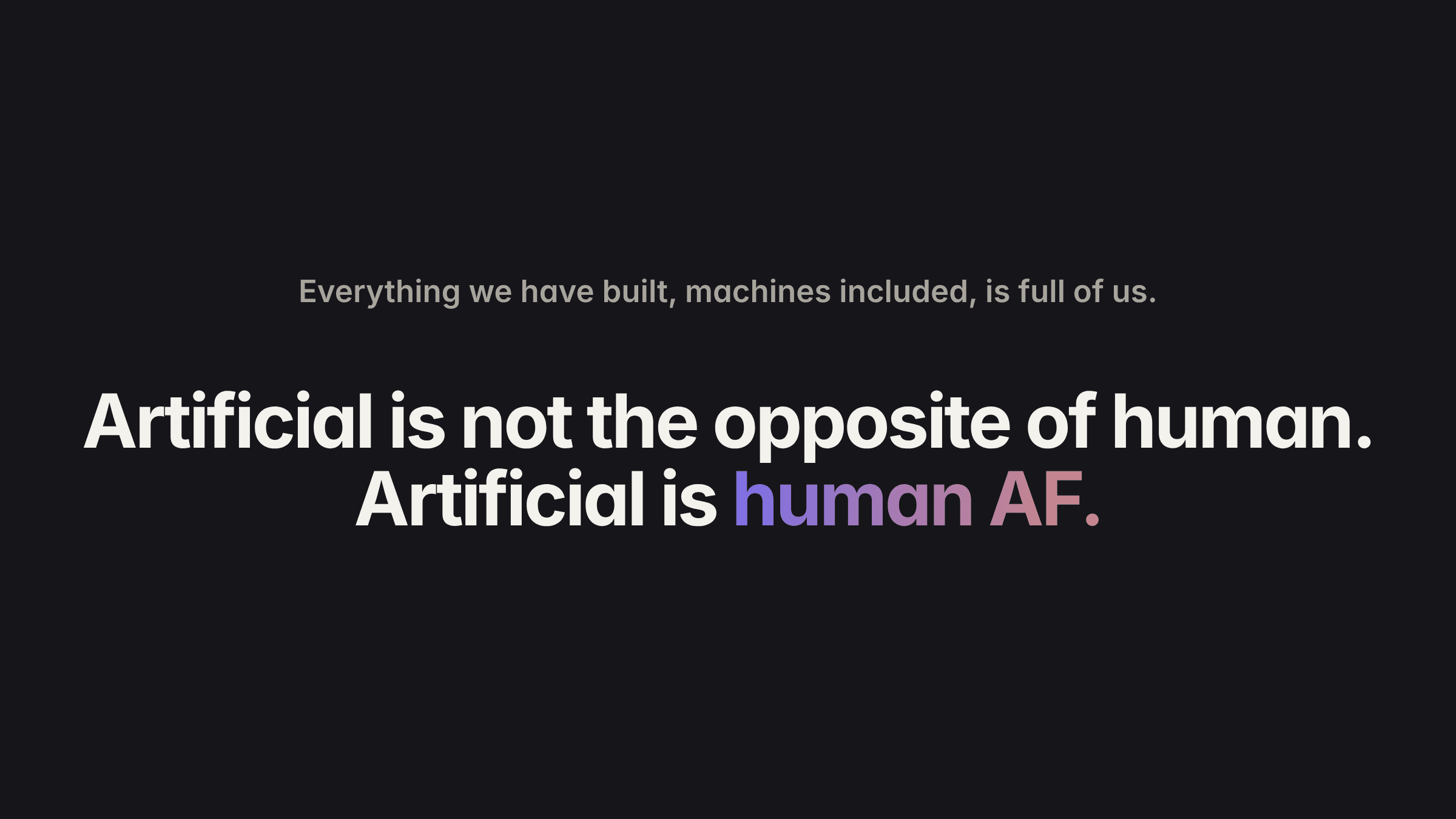
Both mistakes treat the human as something scarce, to be imitated or protected. Density shows the opposite. The skyline, the Bordighera bookshop, the models: everything we have built, machines included, is full of us.
Artificial is not the opposite of human. Artificial is human AF.
This piece adapts Human Density, the talk Luca Morena gave at Supernova Agencies 2026, hosted by wethod at H-FARM, Roncade, on 1 October. Data: Nextatlas early-adopter community, 300K+ insiders, September 2024 to September 2026, forecasts updated 6 September 2026. More in Cultural Drifts, every two weeks on LinkedIn.
Image credits
- Opening: Xiaoze Xie, Rain of Languages (Buddhist Sutras), 2023
- Bordighera: Luca Morena
- Books: Hannah Arendt, The Human Condition, University of Chicago Press; Lewis Mumford, The City in History, Harcourt; Italo Calvino, Le città invisibili, Einaudi; Bruno Latour, Nous n'avons jamais été modernes, La Découverte
- Neo: 1X Technologies
- TARS: Interstellar (2014), dir. Christopher Nolan
- MicroDuck: LeRobot open-source community
- Charts: Nextatlas, early-adopter community data, last update 6 September 2026
Keep reading in Cultural Drifts
Human Density started as an edition of Cultural Drifts, Luca Morena's newsletter on how good ideas drift into traps and what that reveals about the systems shaping culture. Every two weeks on LinkedIn.
Weekly Insights from Nextatlas
One emerging trend a week, read through the behaviour of 300,000+ early adopters, with the data behind it.
Trend lines, data, and information described in this article emerge from the ongoing analysis performed by Nextatlas on its global observation pool made of innovators, early adopters, and industry insiders. Discover Nextatlas Methodology →