Trust Your Gut: Why the Body Is Becoming the New Intelligence
As AI floods the world with nutritional advice, consumers are tuning it out and tuning into their bodies instead. Nextatlas and the Future Food Institute explore the rise of somatic intelligence in food culture: the growing trend of visceral, instinct-led eating that is reshaping how people choose, trust, and relate to food. Discover the cultural forces, consumer data, and brand signals behind one of 2026's most significant food trends.
Something is shifting beneath the surface of food culture, not in what people eat, but in why they eat it.
In a world flooded with nutritional data, AI-generated dietary plans, and an infinite scroll of health content, a counter-movement is quietly gaining force. Consumers are turning away from labels and logic. They are turning inward, to sensation, to instinct, to somatic intelligence.
This blog is based on our Trust Your Gut trend report, produced in collaboration with the Future Food Institute, which you can download here.
From Optimization to Attunement
The pursuit of cognitive optimization defined the past decade. Nootropics. Biohacking. Quantified self. Brain-boosting superfoods. If it could be tracked, scored, or explained, it was trusted. That era isn't completely over, but its opposite is complicating it.
As AI becomes fluent in language, reasoning, and recommendation, trust is quietly moving elsewhere. When everything can be articulated, explanation itself ceases to persuade. The body — slow, biased, sensory, ancient — re-emerges as the last authority that hasn't been hijacked by algorithms.
Nowhere is this more visible than in food. Nextatlas data shows the signals clearly. Year-on-year growth for "Organic Intelligence" is up +191%. "Trust Your Gut" up +97%. "Gut Reaction" up +74%. These are the vocabulary of a cultural shift already underway, bubbling up from our early adopter community and not simply the fringes.
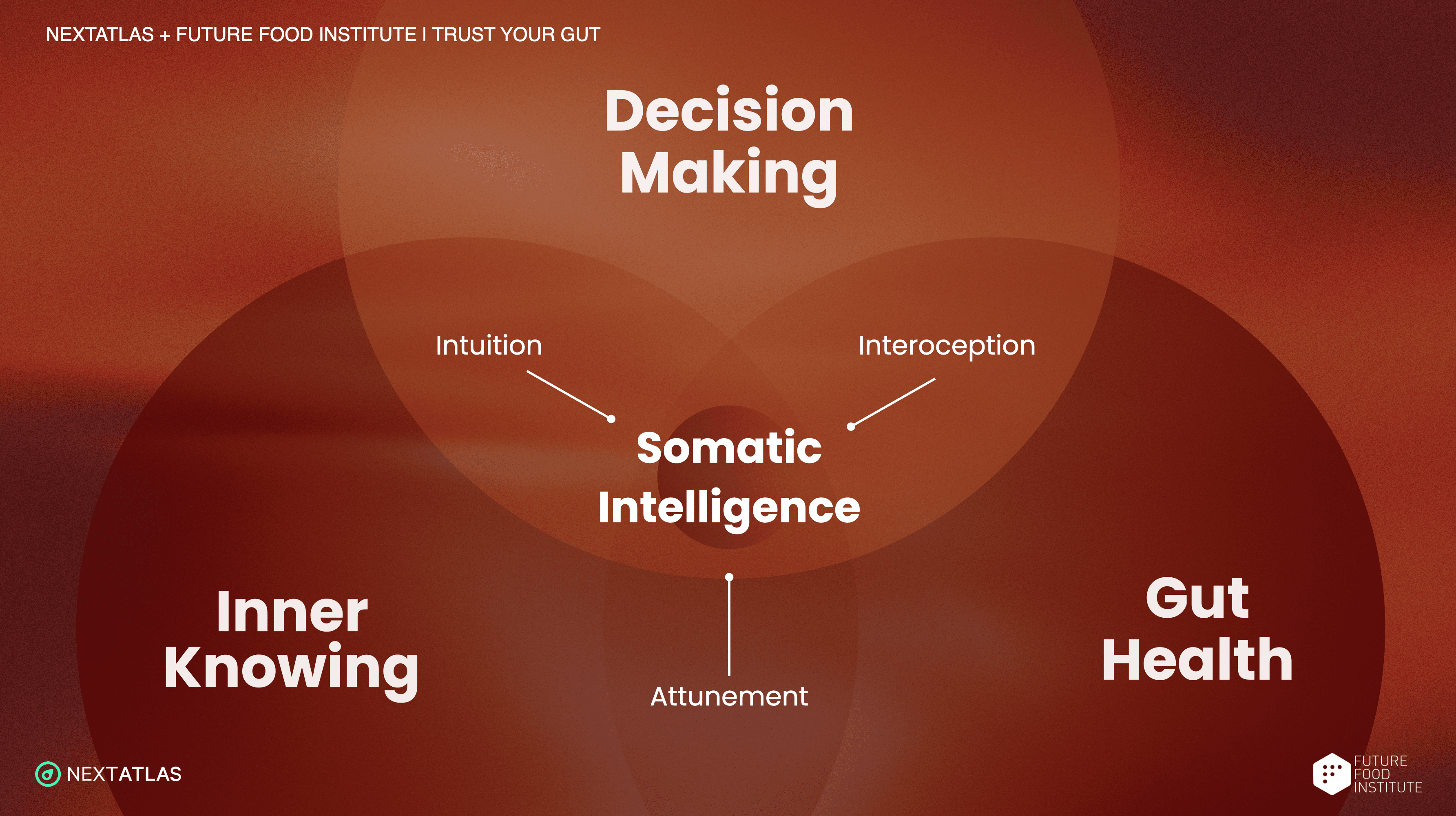
Somatic Intelligence explained (slide from the Trust Your Gut: Food in the Age of Somatic Intelligence report)
The Gut as Cognitive Organ
There's a double meaning at play that matters. "Trust Your Gut" is simultaneously:
- A literal statement about gut health — probiotics, fermentation, the microbiome, the gut-brain axis
- A figurative call to bodily intuition — visceral knowing, somatic feedback, instinctive decision-making
These two meanings are now converging in this movement. The science of the gut-brain axis has been building for years. But what's new is the cultural framing: the idea that a healthy gut doesn't just aid digestion — it sharpens judgment. That tending to your microbiome isn't separate from improving your cognition. That physical and intuitive intelligence are, in fact, the same intelligence.
Somatic intelligence sits at the intersection of gut health, intuition, interoception, and attunement — and it is rising fast across the food and beverage landscape, with Nextatlas projecting 31% growth in the next 12 months.
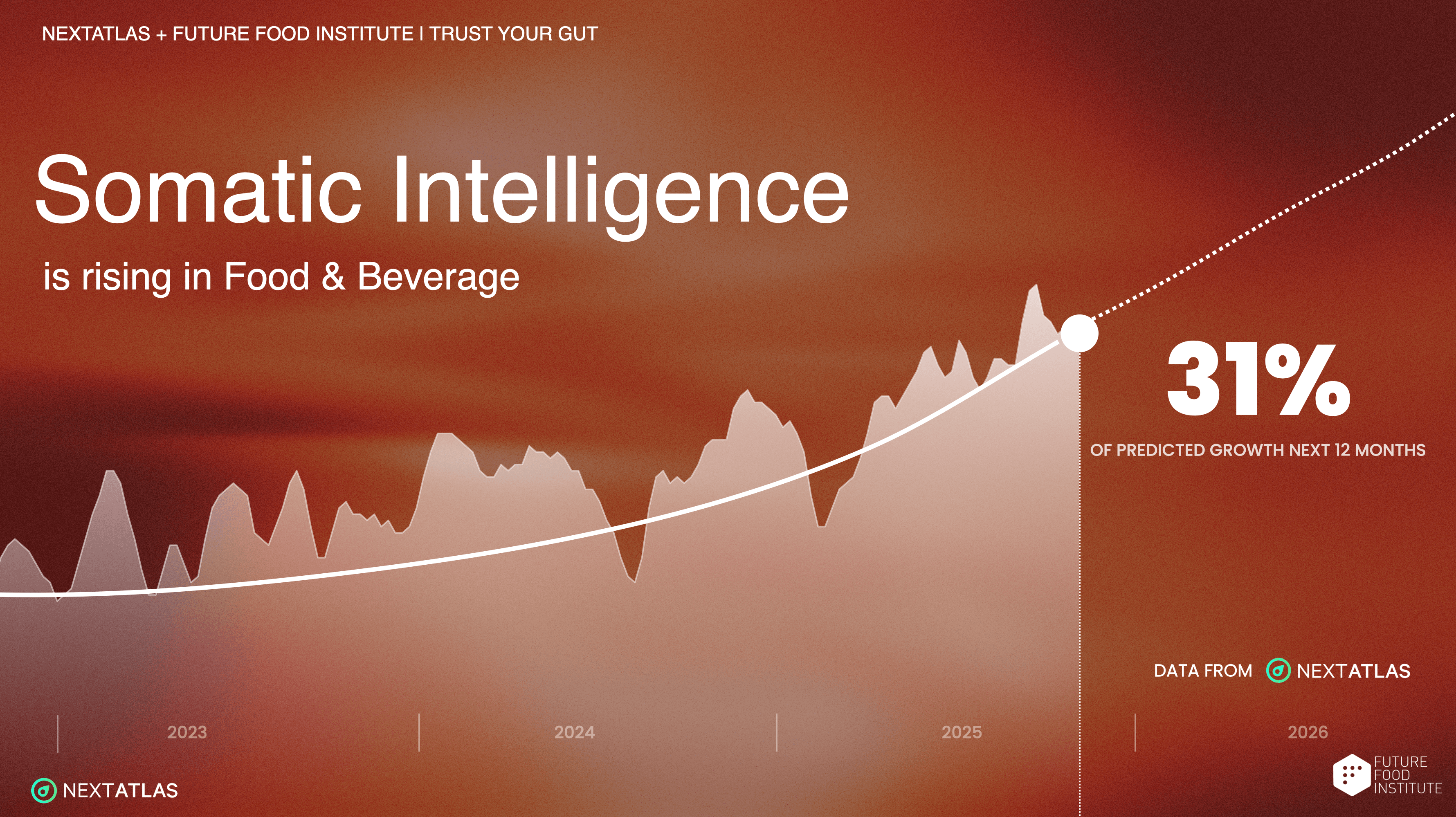
Nextatlas Data: prediction of growth over the next 12 months from the Trust Your Gut: Food in the Age of Somatic Intelligence report
Two Forces Driving the Trend
1. The AI Paradox
Paradoxically, artificial intelligence is accelerating the return to bodily trust. As we delegate more of our reasoning to machines — outsourcing decisions, recommendations, even creativity — people are urgently reclaiming what cannot be automated. Digestion cannot be delegated. Craving cannot be computed. Consumers are leaning into the fact that the gut and gut instinct remain stubbornly human.
2. Nutritional Saturation
In today's world, we don't lack information about food or nutrition because we are drowning in it. In this context, the body itself becomes a more trustworthy guide than any external authority or data. Somatic intelligence is less about knowing what to eat and more about recognizing when something feels right. Value is sensed through texture, warmth, fermentation, and satiety, not processed through rational comparison.
The Demographics Tell the Story
The trend skews strongly toward Gen Z and Millennials — generations raised in environments of infinite information, who are recalibrating trust toward lived, physical experience as a coping mechanism.
It also skews female, reflecting long-standing exposure to diet culture, nutritional scrutiny, and food-related judgment. Somatic intelligence offers these consumers a corrective: permission to prioritize comfort, intuition, and bodily feedback over external standards.
What the Food Professionals Are Seeing
Our ChefAtlas data — drawn from social media posts by a global community of food professionals — shows fermentation emerging as the culinary signal of this trend. Led by culinary educators, fermentation is gaining momentum because it privileges gut-level sensation, warmth, and microbial tactility over explanation.
Kimchi appears across 32,000+ European restaurant menus with coverage growth of up to +180% in Munich, according to our Nextmenu data. Sauerkraut is surging in France with coverage growth of +93.9%. These food trends are rising because they are, in essence, somatic experiences — intensely physical and deeply pre-cognitive.
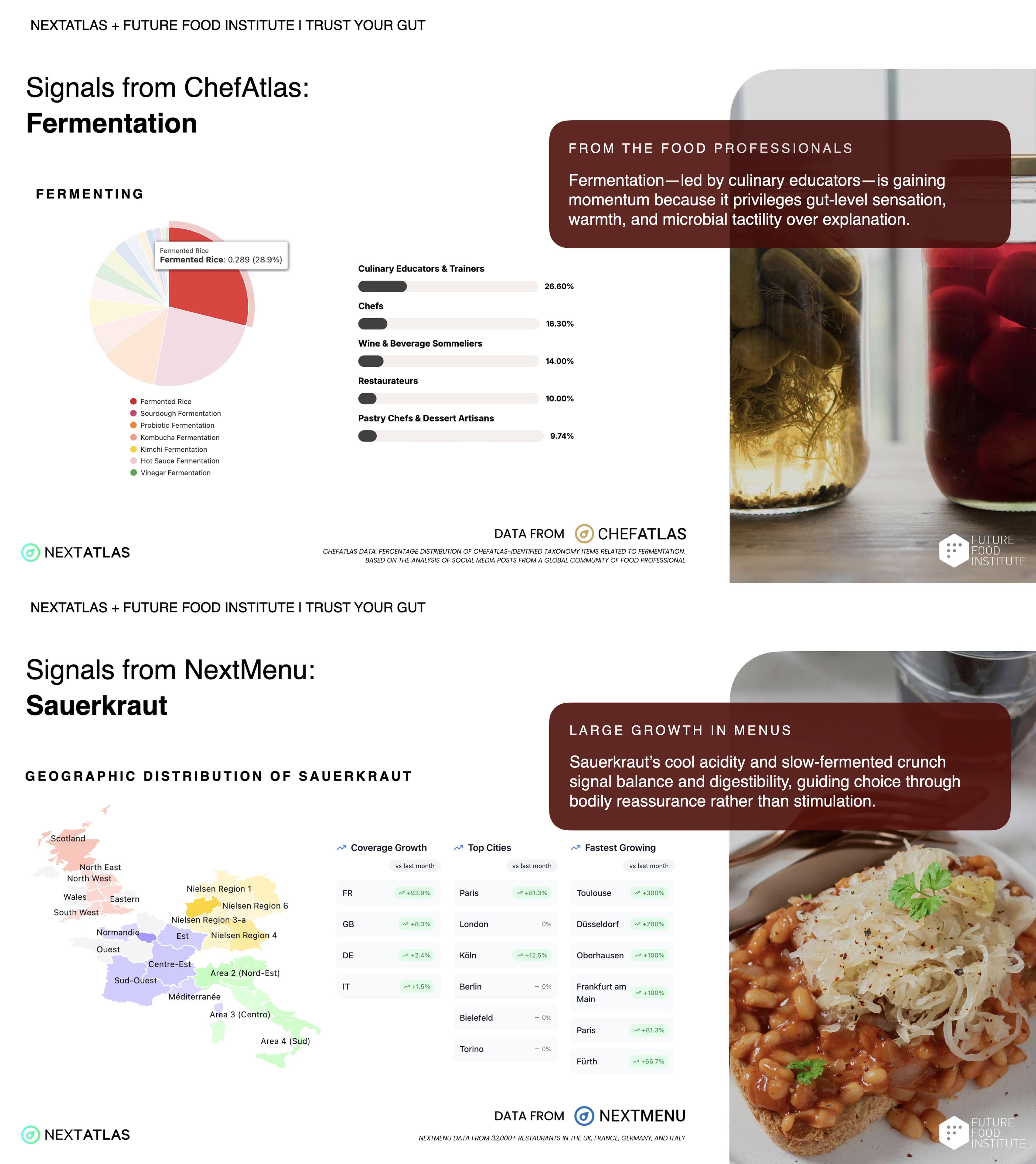
ChefAtlas is a direct pipeline to the world's most innovative chefs, analysing thousands of posts from food professionals to discover tomorrow's ingredients and techniques straight from culinary masterminds. Nextmenu provides real-time menu intelligence that tracks how food ordering trends translate into actual restaurant offerings, giving users access to the future of dining.
So What Does It Mean for Food Culture?
We are witnessing a cultural pivot from optimization to attunement. As systems become smarter, faster, and more predictive, individuals are seeking calibration rather than calculation — tuning into signals of stress, energy, alignment, and emotional charge. Value is increasingly validated through felt coherence rather than logical persuasion.
The implication for food brands is clear: the future belongs to experiences that resonate physically. That aligns with internal rhythms. That can be recognized as true without needing to be explained.
Products must be designed not just to be understood in terms of nutrition or benefits, but to be felt in the sense of goodness and wellness. Through tactility, warmth, fermentation, and satiety. Trust is built not through slogans, but through foods that the body somatically responds to and accepts as real.
Download the Full Report
The Trust Your Gut: Food in the Age of Somatic Intelligence report is available now, produced in collaboration with the Future Food Institute. Powered by 93% prediction accuracy, tracking 1.6M tags across 300K early adopters, and analyzing +2.5M new posts weekly — this is the intelligence your brand needs to stay ahead.
Trend lines, data, and information described in this article emerge from the ongoing analysis performed by Nextatlas on its global observation pool made of innovators, early adopters, and industry insiders. Discover Nextatlas Methodology →