All Your Selves at Once: Chrono Cultures at the 2026 Halfway Mark
We called Chrono Cultures in November 2025, where we said that nostalgia has gotten much more complicated. Consumers are now inhabiting all their temporal selves at once. Six 2026 cases show exactly how that shift is landing across industries, and what it means for the brands paying attention.
Time is becoming a creative material, with consumers layering past, present, and future to construct identity, reshape time perception, and reject effort as a marker of worth.
The full version of this trend, along with multiple business case studies, is available to read in our “Unknown Unknowns 2026” trend report.
In November 2025, Nextatlas published its annual Unknown Unknowns report and named Chrono Cultures one of the three defining trends for the year ahead. The thesis was that consumers had moved past nostalgia as escape. Instead of retreating into the past or projecting into the future as separate acts, they were beginning to inhabit all their temporal selves simultaneously and past, present, and future were collapsing into a single identity surface. Time, we argued, had stopped being a resource to optimize and become a narrative material, something to layer, loop, and remix.
Five months into 2026, the evidence is everywhere, not just in one category or geography, but across different industries. How has Chrono Cultures taken shape in the first half of the year, and what does it tell us about where consumer culture is heading?
The Opening Act: Spotify Wrapped's Listening Age
Before 2026 had even begun, Spotify handed us the perfect prologue.
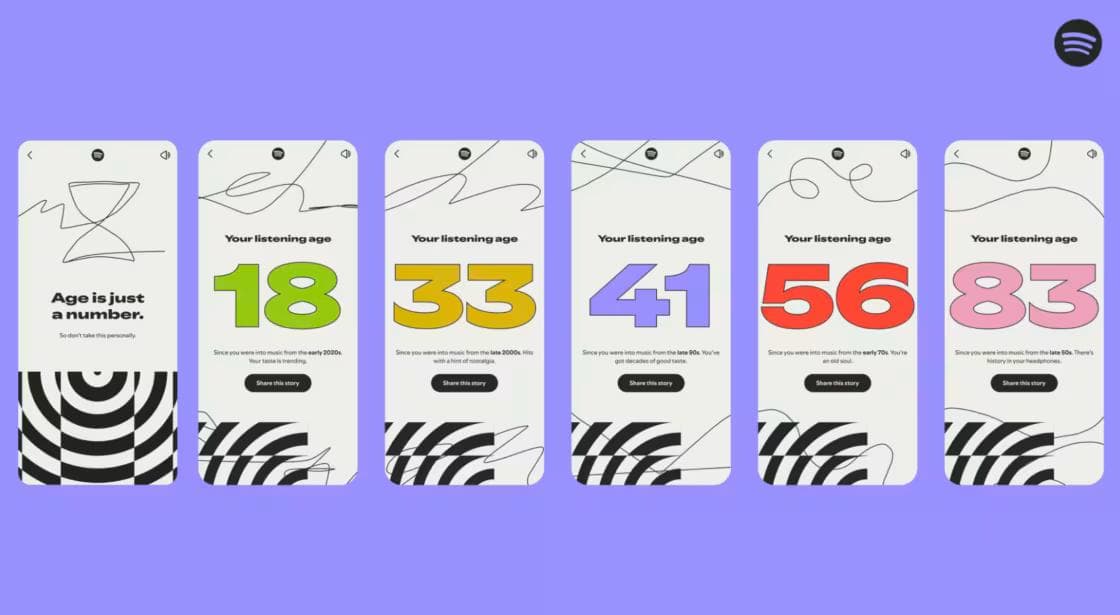
Spotify Wrapped 2025 introduced a feature called Listening Age, a calculation that tells users what decade their musical taste most closely resembles.
Credits: Spotify
The feature was a viral hit, and its sharability is a public acknowledgment that musical identity is no longer linear. People don't only listen to music from their own era. They listen across time, sampling decades they never lived through, holding onto sounds from their childhood, and layering all of it into a single sonic self-portrait.
This is Chrono Cultures made interactive. Listening Age reveals that consumers are actively curating from multiple eras at once to create a time-self mirror with Spotify's help. The nostalgia cycle has matured into something more complex: temporal identity as a daily practice.
Fashion: Levi's "Perfect Imperfections"
Levi's Vintage Clothing opened 2026 with one of the most striking archive releases in recent memory. The "Perfect Imperfections" collection reproduced 1944 501 jeans: WWII-era denim, from the moment when US government rationing forced Levi's to strip the garment of rivets and alter the arcuate. Each pair in the 2026 release was intentionally inconsistent, where some had crooked arcuates, some with upside down labels, and some had the red tab missing entirely.

Credits: carousell.com
Levi's avoided a romanticized homage with rose-tinted nostalgia but instead, it reproduced the imperfection and the constraint of wartime. Wearing these jeans means wearing a specific moment in time, an historically accurate one rather than idealized, full of its own particular limitations and ingenuity.
The consumer who buys this piece is layering 1944 onto 2026, thus making themselves a living archive. That is the temporal simultaneity Chrono Cultures describes: vintage as identity material, not vintage as aesthetic.
Entertainment: The Eternal Playlist Urn by Liquid Death x Spotify
If Listening Age was Chrono Cultures as self-reflection, the Liquid Death x Spotify Eternal Playlist Urn was Chrono Cultures taken to its absurdist extreme.
Launched on February 24, only 150 units were produced, priced at $495 each. It's a 7-by-11-inch urn with a Bluetooth speaker built into the lid to allow your music to follow you into the afterlife. Spotify even built an Eternal Playlist Generator to help users curate the soundtrack for what comes after for a playlist synced directly to the urn.

Credits: Liquid Death
Read literally, this is a novelty product. However, read through the lens of Chrono Cultures, it is something more revealing. The urn collapses the boundary between the living self and the legacy self. It treats a curated playlist as a permanent identity artifact, a temporal investment that persists beyond death. The consumer who engages with this is thinking about time as something to be shaped and extended.
The conversation it generated was enormous and it sold out. Chrono Cultures is showing up both in the reaction and in the product itself, as people want to think about their temporal selves, and brands that give them a frame for that are winning attention.
Tech: Opera's Web Rewind
Web browser Opera turned 30 in 2026 and chose to mark the occasion with Web Rewind, an interactive archive of internet history that lets users scroll through the evolution of the web from 1995 to the present, complete with authentic sound design, keyboard navigation, and recreations of iconic digital moments.
The experience is structured around chronological exploration, but it works as a collective temporal self-portrait. Users submit their own memories as well as observing and exploring the archive. What was your first file downloaded from Limewire? What did you experience online in 2001? The submissions become part of the timeline.

Credits: Opera
This is Chrono Cultures as platform design. Opera is asking users to locate themselves across time, to recognize that their digital identity is layered across decades of internet culture, from dial-up to social media to whatever comes next. The archive is both communal and personal. Users see themselves not as they are now, but as they have been across every era of the web they ever inhabited.
The campaign even made the prize temporal: submit your internet memory for a chance to win a trip to CERN, the birthplace of the World Wide Web. Even the prize routes time backward to 1989.
Health and Wellness: Hone Health's "Death to Midlife"
On February 22, 2026, Hone Health took out a full-page ad in the Sunday New York Times calling for the symbolic death of the word "midlife." A few days later, comedian Whitney Cummings delivered a eulogy roast for the term at Grand Central Terminal. Thousands of commuters were invited to bury aging labels at a communal station, words like "midlife crisis," "senior moment," and "you're not getting any younger," and receive a free "Shot of Life" juice in exchange.
The campaign was built on real data. A January 2026 Hone Health survey found that 73% of adults aged 35 to 65 feel positive about this stage of life, and 71% believe their best years are happening now or still ahead but "midlife" as a cultural frame keeps insisting otherwise.

Credits: Hone Health
Chrono Cultures predicted that one of the defining behaviors of this cycle would be consumers rejecting fixed temporal categories, refusing to be located in a single phase of life and this Hone Health's campaign is a direct embodiment of that. The brand is asking consumers to simultaneously honor their history and reject the label history tries to stick on them. This campaign says that you are not your age, you are all your ages. The funeral for "midlife" is, functionally, a ceremony for temporal simultaneity.
Design: Luna by Robert Spillner
Luna is a kinetic sculpture designed by F1 engineer Robert Spillner. It uses a fluid-filled display to represent the past, present, and future simultaneously, so it becomes a clock that asks you to feel time rather than simply read it. Behind the moving hand, a trace of turbulent patterns marks the touched past and ahead of it stretches calm liquid that contains lunar dust, the untouched future. Only 99 pieces are made per year, each signed and serialized.
Where most objects that relate to time aim to make it efficient, Luna aims to make it perceptible. Spillner describes it as staging time rather than measuring it. In its matte-black wood and acrylic glass frame, it sits on your desk and does nothing except make you aware that time is moving, that past and future exist on either side of your present moment, and that they are made of the same material.

Credits: Robert Spillner
This is the Temporal Cognition strand of Chrono Cultures: a growing appetite for experiences that alter how time feels rather than how it is spent. Luna is a commercial object in the sense that someone buys it and puts it on their wall. But in fact, what they are buying is a different relationship with time itself. Brands that understand this are building products that turn attention to duration, texture, and presence into a premium offer.
The Pattern Emerging Across Industries
Five months into 2026, we can see how our Chrono Cultures trend prediction is spanning multiple industries But what holds them together?
None of these brands are selling nostalgia but they're also not selling the future. They are all doing something more specific: helping consumers inhabit multiple temporal positions at once.
Chrono Cultures is structuring itself around a single underlying shift, that being that consumers have internalized the idea that identity is layered across time, and they want products, platforms, and experiences that honor that complexity. The cycle of nostalgia has matured, where we're not only looking back but looking both back and forward and staying present simultaneously.
That is a significant design brief. The brands reading it correctly in 2026 are the ones already building the products that consumers will look back on as defining this moment.
Discover more in our annual report
Nextatlas tracks early-adopter signals across 42 countries to identify emerging consumer trends before they reach the mainstream. Chrono Cultures was one of the top 3 trends published in our Unknown Unknowns 2026 Annual Report, November 2025. Download it now
Trend lines, data, and information described in this article emerge from the ongoing analysis performed by Nextatlas on its global observation pool made of innovators, early adopters, and industry insiders. Discover Nextatlas Methodology →